Related: Software engineering | CMPSC 360
Topic: Core concepts in compiler design and language theory - understanding how scanners use finite automata to tokenize source code.
Implementing Regular Expression
Regular expressions are equivalent to finite automata
Scanners
A scanner is a lexer that converts source code into a stream of tokens. It’s just a really good rule follower (regular expression) using patterns to match tokens in the source code.
Finite Automaton
The rules the scanner follow can be converted into a conceptual machine called the finite automaton, its basically a flowchart that reads one character at a time.
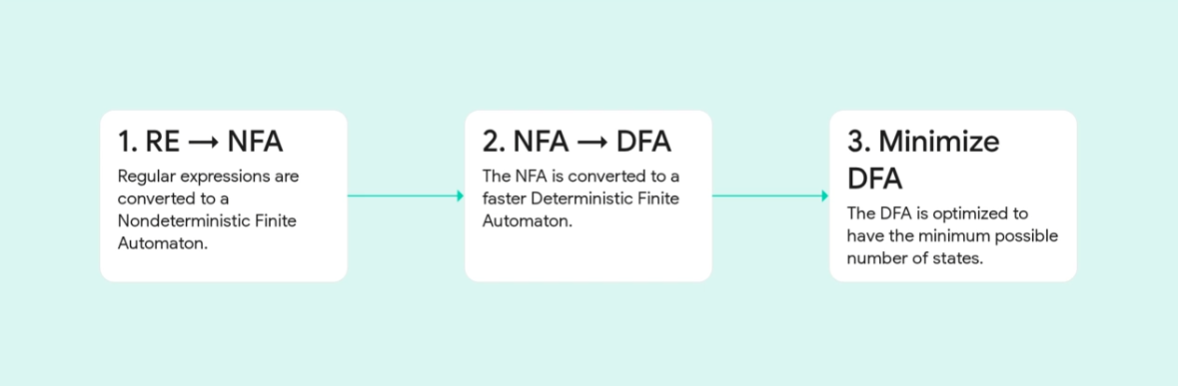
NFA
Nonderministic (Multiple possible paths) Finite Automaton. Slower than a DFA
DFA
DFA Deterministic (One possible path) Finite Automaton. Faster than an NFA, but harder to construct.
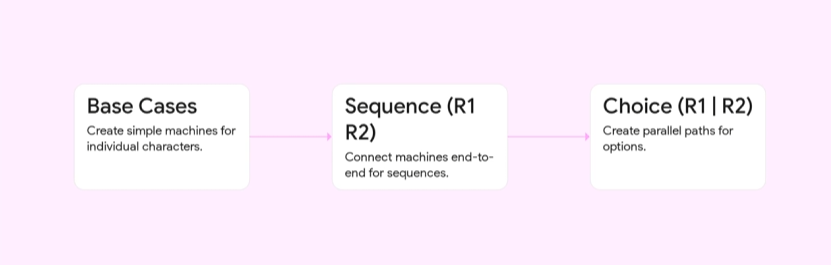
Subset construction
The procedure to convert an NFA to a DFA. This involves creating states in the DFA that represent sets of states in the NFA.
direction LR
Convert
stateDiagram-v2
   direction LR
  [*] --> A0
  B1

  A0 --> A1: A
  A1 --> B0: ε
  B0 --> B1: C
Practice
Hint: Build it as a combination of two simpler regex
Exactly two 0’s
Even number of 1’s
Then combine them together using the union operator.